
Walk into a physical therapy clinic or pain management office and you’ll hear a common mix of terms: iontophoresis, ultrasound, TENS, injections. They often are mentioned in the same breath, sometimes even used on the same day. It’s no wonder patients leave wondering whether these treatments are basically the same thing with different price tags.
They’re not. Each one works in a fundamentally different way, targets pain for different reasons, and makes different tradeoffs. Understanding those differences helps patients ask better questions and set more realistic expectations.
Why These Therapies Get Lumped Together
Part of the confusion comes from the setting. All four treatments are commonly used for musculoskeletal pain, inflammation, and injury recovery. They’re non-surgical and often delivered in outpatient clinics. They also rely on technology rather than pills, which makes them feel interchangeable.
However, similarity in setting doesn’t mean similarity in purpose. Some treatments aim to deliver medication. Others try to influence nerves. Still others focus on tissue healing. Once you separate those goals, the distinctions become much clearer.
What Iontophoresis Is Actually Doing
Iontophoresis is best understood as a drug delivery method, not just a pain modality. It uses a low-level electrical current to push charged medication molecules through the skin and into underlying tissue. The current itself is not the main therapeutic agent; it’s the delivery vehicle.
Clinically, iontophoresis is often used to deliver anti-inflammatory medications directly to a localized area, such as a tendon or joint. The idea is simple: get medication where it’s needed while minimizing how much of it circulates through the rest of the body. That local focus is one of its biggest advantages.
Patients usually feel a mild tingling or warmth during treatment. The sensation is noticeable but typically tolerable. The effect depends on the drug being delivered, the condition being treated, and how the body responds over time. Iontophoresis is not designed to mask pain instantly. It’s meant to support tissue-level changes by delivering medication across the skin barrier.
How Therapeutic Ultrasound Works
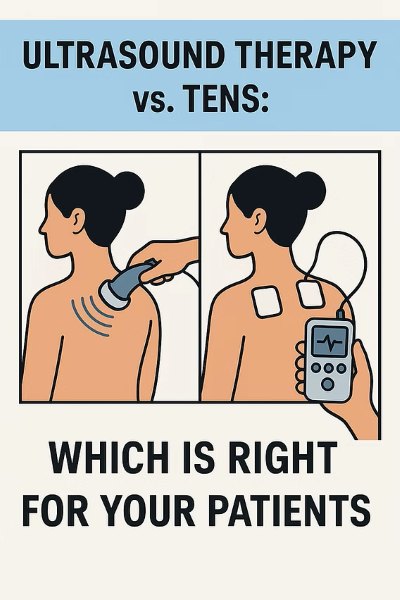
Ultrasound therapy uses high-frequency sound waves, not electricity, to interact with tissue. Those sound waves create mechanical vibrations that can produce gentle heating and movement at a cellular level. The goal is to influence tissue extensibility, circulation, and healing.
Unlike iontophoresis, ultrasound does not deliver medication into the body in standard clinical use. Any gel applied to the skin is there to help transmit sound waves, not to act as a drug. The therapeutic effect comes from how tissues respond to the mechanical energy.
Patients often report feeling warmth or pressure, though sometimes they feel very little at all. Ultrasound is frequently used to prepare tissue for stretching or exercise rather than as a standalone pain solution. Its role is more about creating favorable conditions for recovery than directly addressing inflammation with medication.
What TENS Is Designed to Do
TENS, or transcutaneous electrical nerve stimulation, uses electrical current in a very different way from iontophoresis. Instead of moving drugs, TENS targets nerves. The goal is to alter how pain signals are transmitted and perceived in the brain.
Electrodes placed on the skin deliver pulses that stimulate sensory nerves. This stimulation can interfere with pain signaling to the brain and may also encourage the release of pain-modulating chemicals. The effect is typically temporary and depends on ongoing use.
TENS does not treat the underlying cause of pain in the way medication or tissue-focused therapies might. It is primarily a symptom-management tool. That makes it valuable for some patients and less useful for others, depending on the nature of their condition.
Why Injections Are a Different Category Entirely
Injections bypass the skin barrier altogether. Medication is delivered directly into a joint, muscle, or surrounding tissue using a needle. This allows for precise placement and often a higher concentration of drug at the target site.
The tradeoff is invasiveness. Injections carry risks related to infection, tissue irritation, and systemic absorption, depending on the medication. They can also be uncomfortable and may not be appropriate for repeated or frequent use.
Compared to iontophoresis, injections are more direct and often more potent. Compared to ultrasound or TENS, they are fundamentally medical procedures rather than physical modalities.
Different Tools for Different Jobs
One reason no single therapy replaces the others is that they answer different clinical questions. Iontophoresis is a way to deliver medication locally without a needle. Ultrasound influences tissue behavior mechanically. TENS modifies how the body perceives pain neurologically. Injections quickly and directly place medication at a specific site.
Of course, some of these therapies may overlap because pain is complex. Inflammation, nerve sensitivity, tissue stiffness, and movement patterns are all components of what the body registers as “pain.” A clinician may choose one modality or combine several based on which factors matter most in a given case.
Making Sense of Recommendations
When a provider suggests one of these therapies, the most useful follow-up question is not “Does it work?” but “What is this meant to do for my specific problem, and how does it accomplish that?” A clear answer should refer to the mechanism, not just tradition or habit.
Understanding the differences doesn’t require a medical degree. It requires recognizing that pain treatments are not interchangeable gadgets; they are tools with distinct purposes. When patients understand that, the treatment plan stops feeling arbitrary and starts making sense.